

Construction Loans in Newport Beach, CA: New Builds, Rebuilds and Major Renovations
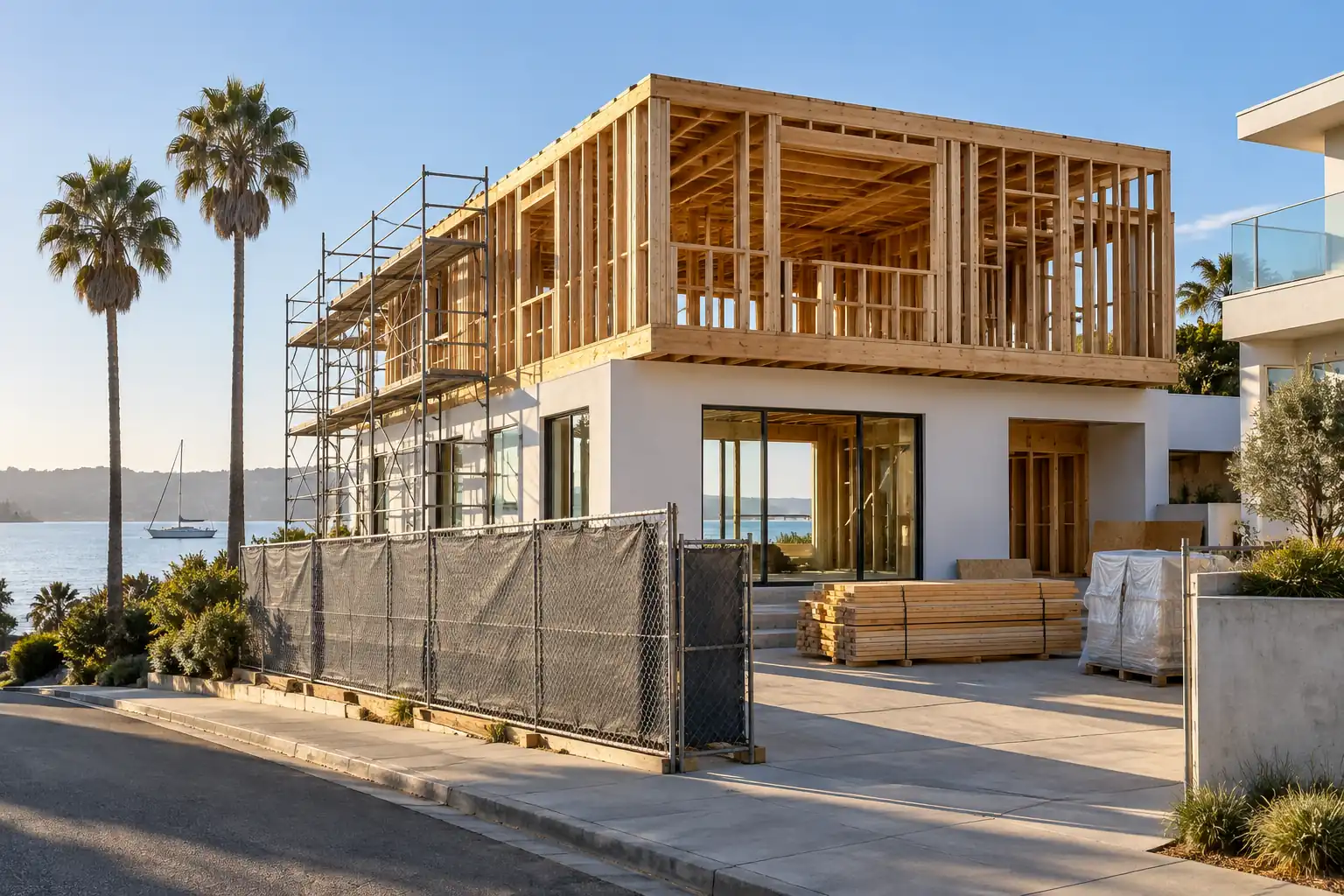
A construction loan in Newport Beach funds a ground-up new home, a tear-down and rebuild or a major renovation in stages, called draws, as the work passes inspection, and is then paid off or converted into a permanent mortgage. Newport Beach home values sit at the top of the Census scale: the median value of an owner-occupied home in the city falls in the survey’s top bracket of $2,000,000 or more, against $962,600 for the county, according to U.S. Census QuickFacts (2020-2024 American Community Survey).
At that price level, many build loans run above the 2026 conforming limit. This page covers project types, draws, loan structures, city permits, coastal rules and a worked example.
What projects can a construction loan cover in Newport Beach?
A construction loan in Newport Beach can cover three kinds of projects: a new home on a vacant lot, a tear-down and rebuild on a lot you already own, and a major renovation or addition to an existing home. The draw process is the same for all three; the valuation and city review differ.
Ground-up new build on a lot
A ground-up loan can pay for the lot and the construction together when you buy the land with the loan. The lender reviews the plans, the budget and the builder, then sizes the loan against the cost and the appraised value of the finished home.
Tear-down and rebuild
A tear-down and rebuild loan pays off any mortgage on the existing house and funds demolition and the new home. The lender values the project on the new home, not the house being removed.
Major renovation or addition
A renovation construction loan funds a large remodel or addition through the same draw process, with the value judged on the home as it will be after the work. It suits work that changes the structure, size or value of the home. Countywide options are summarized in our guide to construction loans in Orange County.
How does a construction loan pay out during the build?
A construction loan pays out in draws: the lender releases money to the builder or suppliers after each stage of work is inspected, instead of handing over the full amount at closing. The draw schedule, inspection method and fees are set by each lender and listed in the loan documents.
- Inspections: an inspector checks progress before each draw, and lender inspection and draw fees are loan costs that must appear on your disclosures.
- Interest during construction: payments are often interest-only during the build, and many loans charge interest only on money actually advanced, a structure covered in Regulation Z Appendix D.
- Contingency: lenders commonly want a contingency line in the budget for overruns; the required amount depends on the lender and the project.
Construction-to-permanent or stand-alone construction loan: which fits?
A construction-to-permanent loan fits borrowers who want one closing that turns into a long-term mortgage when the home is done, while a stand-alone construction loan fits those who plan to refinance, sell or pay off the build loan separately. The right one depends on the loan size and how long the build will take.
| Feature | Construction-to-permanent | Stand-alone construction |
|---|---|---|
| Closings | One closing covers the build and the permanent mortgage | One closing for the build, then a separate permanent loan or payoff |
| After completion | Converts to permanent financing | Must be repaid or refinanced |
| Qualifying | Underwritten on the permanent loan’s terms | Qualify for the build loan, then again for the new mortgage |
| Suits | Owner-occupants with a fixed plan and timeline | Longer or more complex builds, or a planned sale |
Source: Fannie Mae Selling Guide B5-3.1-02 (05/06/2026). Lender programs outside Fannie Mae set their own terms.
Fannie Mae’s single-closing version limits any single construction period to 12 months and the total to 18 months, and Fannie Mae buys the loan only after the home is complete. If you buy the lot with the loan, the loan-to-value uses the lesser of lot price plus construction cost or the as-completed appraised value; if you already own the lot, it uses the as-completed value. A Fannie Mae loan must also fit the 2026 Orange County conforming limit of $1,249,125 for one unit, set by FHFA. Larger permanent loans move into jumbo loans in Newport Beach, where lenders set their own construction rules.
What Newport Beach permits do you need before construction starts?
You need an issued building permit from the City of Newport Beach before construction starts, and lenders typically ask for the permit and approved plans in hand before the first draw. The Building Division of the Community Development Department runs plan check and inspections.
Plan check applications for new buildings, additions and remodels can be submitted through the City’s CiViC online permitting system. The City also limits how long a build can take: for one-unit and two-unit dwellings, work under a building permit must be completed within three years of the first permit, unless an extension is granted, under NBMC Section 15.02.095 (effective June 1, 2019). Final inspection marks completion, and a new permit for the same project does not restart the clock. Plan your loan term and contingency around that limit.
Do you need a coastal development permit to build in Newport Beach?
It depends on the lot: most single-unit and two-unit projects in Newport Beach are excluded from coastal development permit (CDP) requirements, but lots in the first row along the shoreline and in the Bay Shores community generally are not. The California Coastal Commission certified the City’s Local Coastal Program effective January 30, 2017, so the City now issues CDPs for most projects, according to the City’s Local Coastal Program FAQ.
The exclusion, Categorical Exclusion Order CE-5-NPB-16-1, carries conditions, including two parking spaces per unit and notice to the Coastal Commission at least 5 working days before construction begins. The Commission keeps permit authority over submerged lands and tidelands, and City-approved CDPs in appeal areas can be appealed to it. For a bayfront or oceanfront build, add the CDP step to the timeline before you lock in a closing date.
What does a Newport Beach construction loan look like? A hypothetical example
Hypothetical example, round numbers: an owner has a $500,000 mortgage on an older Newport Beach house and plans to tear it down and rebuild. The construction budget is $2,000,000, including a $200,000 contingency, and the appraiser values the finished home at $5,000,000.
A $2,500,000 construction loan pays off the $500,000 mortgage at closing and releases the $2,000,000 budget in draws. The $2,500,000 loan equals 50% of the as-completed value. If the loan charges interest only on funds advanced, interest starts small and grows with each draw. Because the loan is above $1,249,125, it would be a jumbo or portfolio loan rather than a Fannie Mae loan. Closing costs, inspection fees, property tax and insurance come on top.
Frequently asked questions
Can you get a construction loan for a tear-down in Newport Beach?
Yes. A construction loan can pay off the existing mortgage and fund demolition and the new home, with the lender sizing the loan against the finished home’s appraised value.
Can you use a construction loan if you already own the lot?
Yes. Under Fannie Mae’s single-closing rules, an owned lot is treated as a limited cash-out refinance, and the loan-to-value is based on the as-completed appraised value. Jumbo lenders set their own rules for land equity.
How long can a construction loan last in Newport Beach?
It depends on the lender and the program. Fannie Mae’s single-closing loans allow up to 18 months of construction in total, and the City expects a one-unit or two-unit build to be completed within three years of the first permit unless extended.
Do you need a jumbo loan to build in Newport Beach?
Often, yes. Any loan above the 2026 Orange County conforming limit of $1,249,125 for one unit is a jumbo loan, and many Newport Beach builds exceed that amount. 2027 limits were not yet announced on November 10, 2026.
Is a construction loan the right tool for an investor who plans to sell?
Usually not. Owner-occupant construction loans are built around living in the finished home, so investors who plan to rebuild and sell often use fix and flip hard money loans in Newport Beach instead.
Talk through a construction loan in Newport Beach with Newport Capital Funding
Newport Capital Funding serves borrowers across Orange County from Newport Beach. Bring your plans, your budget and your builder’s details. Contact Newport Capital Funding and we can walk through which loan structure fits your project, how draws would work and what the lender will ask for.
This page provides general information. Eligibility, rates and terms depend on the borrower, property, loan program and current underwriting review. Program details and limits can change. It is not tax or legal advice. NMLS ID# 1041553.